
Choosing a Backpacking Power Bank: Reserve, Weight and Weather
By Robert PetersonWhen you carry everything on your back, useful features matter. The Techsmarter Rugged 10K 22.5W weighs 8 oz, while the Rugged 20K 30W weighs 17 oz and doubles the rated capacity. Both combine IP66 protection with a closed cover, wireless charging and a flashlight. Here is how to choose the reserve that earns its place on your next trail.
Make an essential-device list
List the devices you will rely on and how you expect to use them. A phone used for photographs and occasional map checks has a different pattern from one used continuously for navigation or recording. Add any USB-rechargeable accessories you actually carry.
Give navigation and essential communication first place in your charging plan. Then add reserve for photos, lights and a longer day on the trail. That puts your battery capacity to work on the parts of the trip that matter most.
Compare the complete carried kit
Include the bank, cable, adapter and any pouch when judging pack weight. A larger bank may provide useful reserve, but an extra cable or heavy wall adapter also takes space. Check the product’s actual dimensions and weight rather than assuming capacity alone determines portability.
Organize the kit so you can charge during a dry rest stop without unpacking everything. Check cable length against where the phone and bank will sit. A tidy, tested arrangement is easier to manage than loose gear at the bottom of a bag.
Two rugged options to shortlist
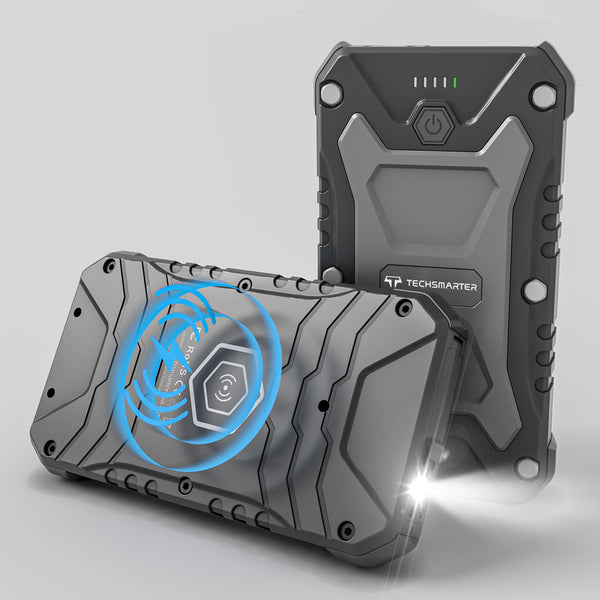
The TSBar Rugged 10,000mAh 22.5W offers a lower-capacity option to compare for a phone-focused kit. The TSBar Rugged 20,000mAh 30W provides a larger advertised battery reserve and up to 30W USB-C PD.
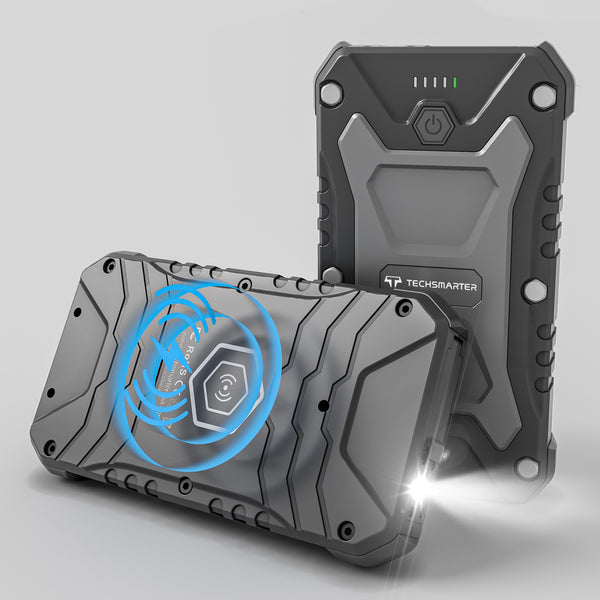
Wireless charging and a flashlight give both models useful roles at a dry rest stop or campsite. The 10K is the lighter carry; the 20K adds capacity and up to 30W USB-C PD.
Plan for weather without stretching the rating
Read the exact model’s water-protection instructions. Keep port covers closed around water and use charging connections only when dry. Neither an outdoor product name nor a rugged enclosure makes an exposed charging port suitable for rain.
Protect the charging kit as part of your packing system. Our IP66 versus IP67 guide explains why water-jet and immersion ratings should not be treated as interchangeable.
Test before the longer route
Use the complete kit on a shorter outing and observe how much reserve your normal routine consumes. Keep the starting battery levels and device use in mind when interpreting the result. Add reserve for the longer itinerary instead of treating one short outing as a guarantee.
Compare Techsmarter rugged power banks and choose the smallest practical kit that meets your charging plan with an appropriate margin.
More options for your setup
Compare charging performance and everyday features
| Feature | Rugged 10K 22.5W | Rugged 20K 30W |
|---|---|---|
| Capacity | 10,000mAh | 20,000mAh |
| Estimated full phone charges* | About 1.4 | About 2.9 |
| Maximum wired output | Up to 22.5W wired | Up to 30W USB-C PD |
| Wireless charging | Qi wireless charging | Up to 15W Qi |
| MagSafe-compatible attachment | No magnetic attachment | No magnetic attachment |
| One-hour fast charging for compatible phones | — | — |
| Connections | Wired outputs plus wireless pad | 1 USB-C, 2 USB-A, wireless pad |
| Laptop charging | Designed primarily for phone charging | Compatible lower-power USB-C laptops; compare requirements |
| Waterproof / protection rating | IP66 with cover closed | IP66 with cover closed |
| Convenience features | Flashlight | Flashlight |
| Unpackaged weight | 8 oz / about 227 g | 17 oz / about 482 g |
| Ideal use | Phone-focused hikes | Camp, tablets and phone reserve |
*Illustrative estimates use a 5,000mAh phone battery at 3.85V, power-bank cells at 3.7V and an assumed 75% energy transfer: bank mAh × 3.7 ÷ 1,000 × 0.75 ÷ 19.25. Recharge counts vary with phone, charging method and use; wireless charging can yield fewer charges. A decimal includes a partial recharge.
Use a cable and charging mode supported by your device. Power is shared when several outputs are in use. A dash means the one-hour phone-charging feature is unspecified for that model.
Compare reserve before weighing the complete kit
Choose the Rugged 10K for an 8 oz phone-focused battery pack or the Rugged 20K for twice the rated capacity at 17 oz. Both include wireless charging and a flashlight alongside their wired outputs.
| Listed feature | Rugged 10,000mAh 22.5W | Rugged 20,000mAh 30W |
|---|---|---|
| Capacity | 10,000mAh | 20,000mAh |
| Headline wired output | Up to 22.5W | Up to 30W USB-C PD |
| Listed water protection | IP66, with cover closed | IP66, with cover closed |
| Other listed features | Wireless charging and flashlight | Wireless charging and flashlight |
Compare the unpackaged model weight, then add your cable, pouch and any adapter you will carry. Use measured grams or ounces for that kit, not shipping weight. For a campsite where carrying weight is less restrictive, see the camping power-bank guide.
Unpackaged product weight
| Model | Weight |
|---|---|
| Rugged 10,000mAh 22.5W | 8 oz (about 227 g) |
| Rugged 20,000mAh 30W | 17 oz (about 482 g) |
Product weights confirmed by Techsmarter on September 28, 2026; approximate gram conversions are rounded. Cables, adapters and a carrying pouch add to your packed weight.
The 20K adds 9 oz and doubles rated capacity. Choose it when extra reserve matters more than the lighter 10K carry; actual runtime follows your devices and how you use them.
Frequently asked questions
Is 10,000mAh enough for a hike?
It depends on trip length, devices and use. Start with your own charging plan rather than a universal day-count claim.
Can I charge while the bank is exposed to rain?
Use charging connections only when dry and follow the exact model’s instructions.
Should the built-in flashlight replace my main light?
Plan your primary lighting separately. Treat the feature according to its intended use and stated capabilities.
Choose the features you will use on the trail
The Rugged 10K gives a phone-focused kit a lighter battery pack. The Rugged 20K adds reserve and up to 30W USB-C PD for compatible devices. Wireless charging and a flashlight add practical convenience to both, giving one piece of gear several useful roles at a dry rest stop or campsite.
Compare rugged portable chargers
Need help with your setup? Email support@techsmarterusa.com with your device model.
Sources and product details
- Techsmarter water-protection guide
- TSBar Rugged 10,000mAh 22.5W Power Bank specifications
- TSBar Rugged 20,000mAh 30W Power Bank specifications
Techsmarter model details are available on the product pages linked throughout this guide.